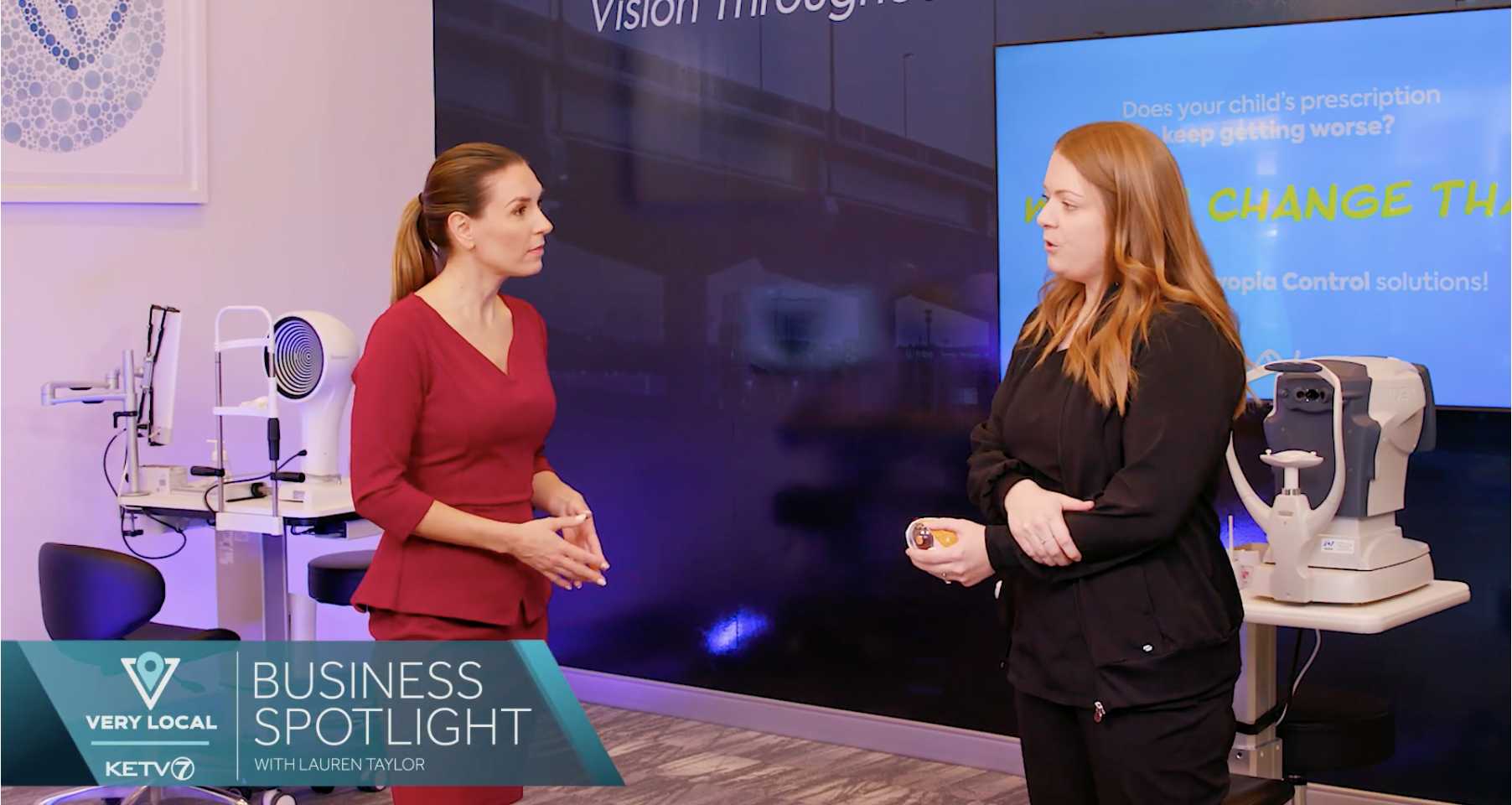
Dr. Meagan Anderson, OD, lead optometrist at Modern Vision Solutions in Omaha, NE, recently visited with KETV to explain what myopia actually is, why it matters for kids, and what parents can do about it today. What she covered in that segment is worth a closer read for any parent who has noticed their child squinting, struggling at school, or moving closer to screens than they should have to.
What is myopia and how do I know if my child has it?
Myopia is the clinical term for nearsightedness, and it means the eye has grown longer than average. When that happens, light entering the eye focuses in front of the retina rather than directly on it, and distant objects blur. In children, this shows up as the kid who can’t read the scoreboard from across the field, or who keeps moving closer to the board at school. As Dr. Anderson explained on KETV, these are the children whose eyes are structurally longer than they should be.
Parents who notice squinting, complaints about distance vision, or a child sitting unusually close to the television have already identified a reason to schedule a comprehensive eye exam. A child with one nearsighted parent is three times as likely to develop myopia; if both parents are nearsighted, that likelihood doubles. Family history alone is a meaningful reason to bring a child in even before obvious symptoms appear.
Is myopia in kids actually dangerous, or is it just bad eyesight?
Myopia carries long-term health risks that go well beyond needing glasses. Dr. Anderson noted in her interview with KETV that children with myopia have roughly double the risk of developing glaucoma or retinal detachment later in life. A glasses prescription addresses the symptom of blurry vision. It does not address the underlying progression of the condition or the elevated risk that comes with it. The higher the degree of myopia a child develops, the greater those risks become — which is why slowing progression during childhood matters clinically, not just optically.
Can myopia in children be treated, or only corrected with glasses?
Myopia in children can be actively treated to slow its progression — this is called myopia control, and it is different from simply updating a prescription. The goal is not to restore perfect unaided vision, but to reduce the rate at which the eye continues to grow longer over time, limiting the degree of nearsightedness a child accumulates and, in doing so, reducing long-term health risk. Studies have shown myopia control treatments can slow progression by up to 50 percent. Modern Vision Solutions offers myopia control in Omaha, NE through a specialized EyeAnalysis exam that tracks the eye’s development over time and informs each child’s treatment plan.
What are the treatment options for myopia control in kids?
Dr. Anderson described three treatment options at Modern Vision Solutions during the KETV segment. Two involve specialty contact lenses, and the third is a prescription eyedrop. Orthokeratology lenses are worn overnight and gently reshape the cornea while a child sleeps, allowing clear vision during the day without any correction in place. Daytime soft contact lenses designed specifically for myopia control work through a different optical mechanism but accomplish a similar goal during waking hours. The third option is atropine, a low-dose eyedrop instilled at bedtime, which suits children who are not ready for contact lenses. Each child at Modern Vision Solutions in Omaha receives a treatment plan based on their specific prescription, age, and the rate at which their myopia is progressing.
At what age should a child start myopia control?
Myopia control can begin as soon as myopia is diagnosed, in some cases as early as age six or seven. Earlier intervention generally produces better outcomes because there are more years of eye development left to influence. Waiting until a prescription stabilizes on its own is not the same as managing the progression — left unaddressed, childhood myopia almost always worsens over time. Dr. Anderson and the Modern Vision Solutions team in Omaha evaluate each child individually and can recommend when to start based on the child’s current prescription trajectory and overall eye health.
Are myopia control contact lenses safe for kids?
Contact lenses for myopia control are safe for children when prescribed and monitored appropriately. The determining factors are not age alone but maturity, hygiene habits, and the child’s own motivation to handle lenses responsibly. Side effects from myopia control treatments are generally minimal and are monitored at follow-up appointments, which typically occur every six months. For children who are not ready for contact lenses, the atropine drop option provides an effective alternative with no lens handling required.
If you have noticed signs of nearsightedness in your child, or if myopia runs in your family, a pediatric eye exam at Modern Vision Solutions is the right place to start. Schedule an appointment at mvsvision.com or call 833-586-2020.
Full KETV Interview Transcript on Myopia Control at Modern Vision Solutions
Host: Get ready for another Very Local Business Spotlight. Today we’re back at Modern Vision Solutions talking to Dr. Anderson about myopia in kids.
Dr. Anderson, what is myopia and how does it specifically affect children?
Dr. Meagan Anderson: Yes, so myopia is a term that just means nearsightedness. So, these are the children that can’t see the scoreboard across the field or can’t see the board at school when their teacher is talking. And what that means is the eye is actually longer than average. And so when light is entering the eye, it focuses in front of the retina, which causes things to be blurry.
Host: And what are the long-term risks of myopia?
Dr. Meagan Anderson: Some of the risks are that they can actually have double the chance of getting cataracts, glaucoma, or even retinal detachment. So, it’s definitely a big deal.
Host: And Modern Vision Solutions offers several treatments for myopia. What are those?
Dr. Meagan Anderson: Yes, so we call that myopia control, and basically the goal of that is to slow down the progression of nearsightedness, essentially slowing down the length of the eye from growing so long. And there’s three different ways to do that, two of which are a specialty contact lens that they can wear, and then there’s also an eyedrop that they can instill into their eyes at bedtime.
Host: So, if parents think that this is possibly affecting their children, they can just make an appointment here with you?
Dr. Meagan Anderson: Absolutely, yes.
Host: All right, thank you so much, Dr. Anderson.

Modern Vision Solutions is a full-scale vision center committed to empowering our patients with the best vision scientifically and medically achievable – whether their best solution is glasses, contacts, or a vision correction procedure. At Modern Vision Solutions, we help our patients achieve the freedom that clear vision can provide. We do this through an unparalleled patient experience and world-class, lifelong vision care. When we partner with a patient for their eye health and vision needs, our patient’s priorities become our priorities. We get to know our patients’ stories, and customize a vision correction solution around their hobbies, dreams, and job requirements. You deserve to live a lifestyle free from visual barriers.